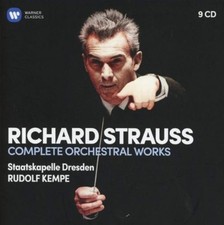
Richard Strauss
Richard Georg Strauss (; German: [ˈʁɪçaʁt ˈʃtʁaʊs] ; 11 June 1864 – 8 September 1949) was a German composer and conductor known for his tone poems and operas. He was a leading figure of the late Romantic and early Modern era. His first tone poem to achieve wide acclaim was Don Juan. This was followed by other lauded works of this kind, including Death and Transfiguration, Till Eulenspiegel's Merry Pranks, Also sprach Zarathustra, Don Quixote, Ein Heldenleben, Symphonia Domestica, and An Alpine Symphony. His first opera to achieve international fame was Salome. This was followed by Elektra, Der Rosenkavalier, Ariadne auf Naxos, Die Frau ohne Schatten, Die ägyptische Helena, Arabella, Daphne, Friedenstag, Die Liebe der Danae and Capriccio. Other well-known works by Strauss include two symphonies, lieder (especially the Four Last Songs), the Violin Concerto in D minor, the Horn Concertos Nos. 1 and 2, his Oboe Concerto, and other instrumental works such as Metamorphosen. A prominent conductor in Western Europe and the Americas, Strauss enjoyed quasi-celebrity status as his compositions became standards of orchestral and operatic repertoire. He was chiefly admired for his interpretations of the works of Liszt, Mozart, and Wagner in addition to his own works. A conducting disciple of Hans von Bülow, Strauss began his conducting career as Bülow's assistant with the Meiningen Court Orchestra in 1883. After Bülow resigned in 1885, Strauss served as that orchestra's primary conductor for five months before being appointed to the conducting staff of the Bavarian State Opera. He served as principal conductor of the Deutsches Nationaltheater und Staatskapelle Weimar from 1889 to 1894. In 1894 he made his conducting debut at the Bayreuth Festival. He returned to the Bavarian State Opera before becoming principal conductor of the Berlin State Opera and then the Vienna State Opera. In 1920 he co-founded the Salzburg Festival. In 1933 Strauss was appointed to two important musical positions in Nazi Germany: head of the Reichsmusikkammer and principal conductor of the Bayreuth Festival. These positions have led some to criticize Strauss for his seeming collaboration with the Nazis. However, Strauss's daughter-in-law was Jewish, and much of his apparent acquiescence to the Nazi Party was done to save her life and the lives of her children. He was also apolitical, and took the Reichsmusikkammer post to advance copyright protections for composers, attempting as well to preserve performances of works by banned composers. Further, Strauss insisted on using a Jewish librettist, Stefan Zweig, for his opera Die schweigsame Frau which ultimately led to his firing from the Reichsmusikkammer and Bayreuth in 1935, just two years after his appointment. Strauss's opera Friedenstag, which premiered just before the outbreak of World War II, was a thinly veiled criticism of the Nazi Party that attempted to persuade Germans to abandon violence for peace. Thanks to his influence, his daughter-in-law was placed under protected house arrest during the war, but despite extensive efforts he was unable to save dozens of his in-laws from being killed in Nazi concentration camps. In 1948, a year before his death, he was cleared of any wrongdoing by a denazification tribunal in Munich.
This article uses material from the Wikipedia article "Richard Strauss", which is released under the Creative Commons Attribution-Share-Alike License 3.0.
References
| Title | Summary | |
|---|---|---|
| Alan Corbett | ... growing old. No, he didn`t play Richard Strauss ' Four ... | |